Review by Piers Beagley - Elvis Information Network
Elvis was back at the top of the charts and on a high when he returned to the studios on June 4 1970.
Having fallen out with Chips Moman and American Sound studios, Elvis was back at Nashville's Studio B. At the Memphis sessions Elvis was striving at his artistic edge, recording in the run-down ghetto area of Memphis and hoping to re-establish himself once again as a creative force.
Sixteen months since his last sessions, Elvis was now back in the far more genteel surroundings of Nashville once again in Studio B where he had recorded the majority of his 1960s classic songs. 'Kentucky Rain' and 'The Wonder Of You' had already charted Gold in 1970, while he had two sell out seasons of Las Vegas shows under his belt as well. He was now also used to playing live concerts with full orchestral backing.
By moving back to Nashville, Elvis also left the musical “soulful stew” of Memphis behind for an obviously lighter country feel. Even within this very different environment Elvis was still extremely motivated and recorded an astounding forty songs in six days. The original plan was just to record a follow up album to Back In Memphis, but on the fourth night of recording Elvis himself steered the band towards some fascinating country tunes.
These recording sessions have been explored before on the excellent A Hundred Years From Now: Essential Elvis Volume 4 and this new CD should be viewed as a part 2. However, nine of the tracks have never been released as alternate takes before and the versions of 'Mary In The Morning' and 'Twenty Days And Twenty Nights' alone are reason enough to buy this CD.
I have also always enjoyed listening to first takes of Elvis' songs and The Nashville Marathon features eight of those, including the sensational 'Bridge Over Troubled Water'.
Unfortunately (as Ernst Jørgensen explained at the FTD conference), most of the fast numbers were recorded in single takes; any available alternates have already been released. This forces this CD to be very ballad orientated.
However, the absolute beauty of the undubbed raw studio tracks once again makes this one of FTD's very best.
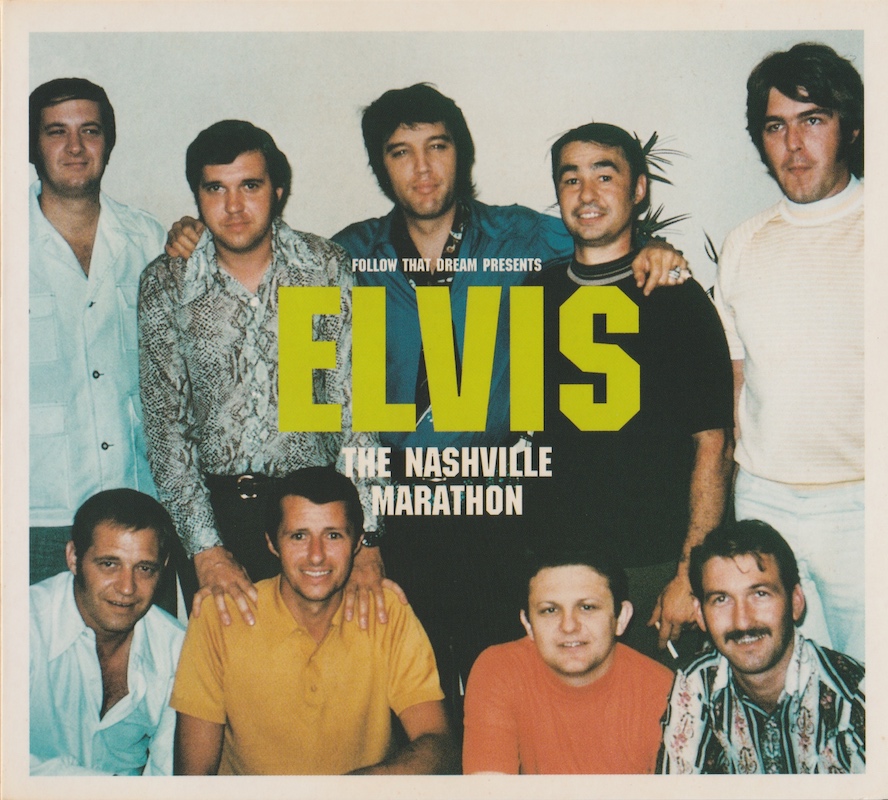
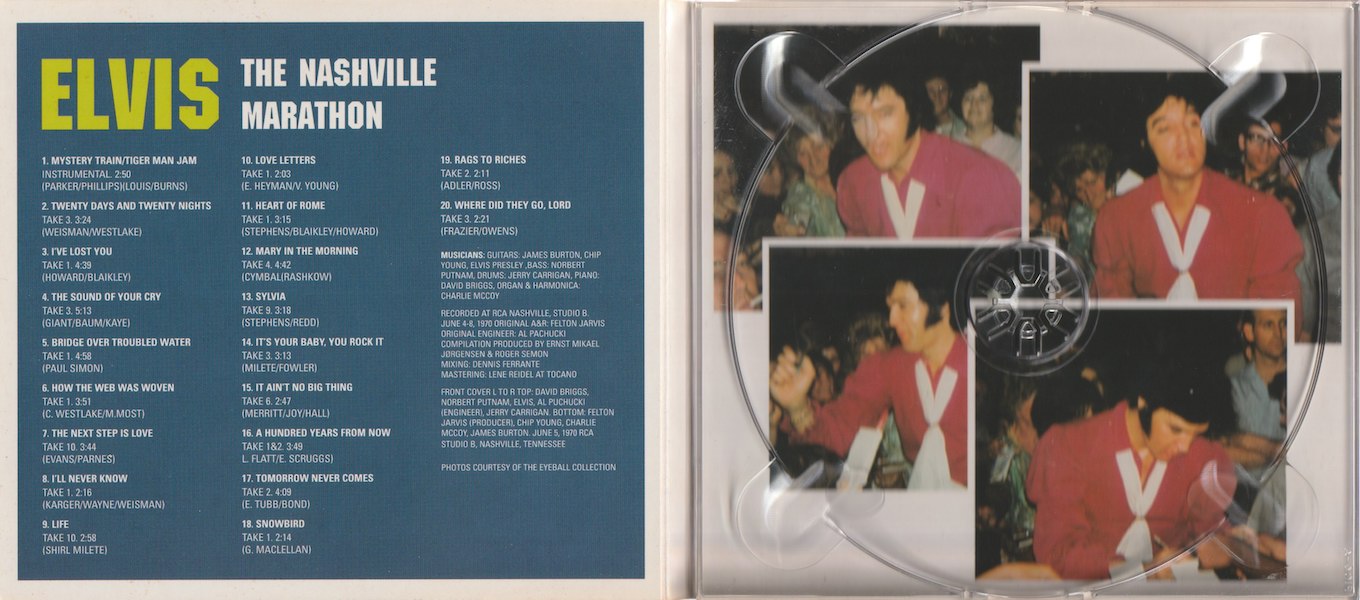
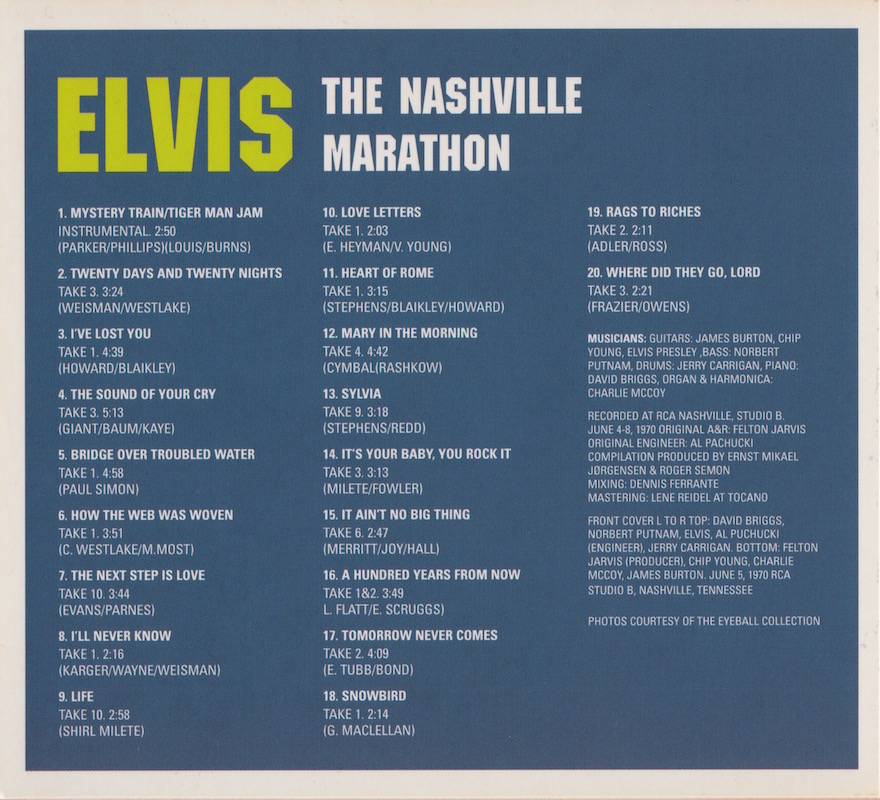
The Nashville Marathon musicians - David Briggs, Norbert Putnam, Elvis, Al Pachuki, Jerry Carrigan. Bottom Row: Producer Felton Jarvis, Chip Young, Charlie McCoy, James Burton.
Looking a little closer ….
'Mystery Train’/’Tiger Man' - A similar opener to the jam at the beginning of A Hundred Years From Now, this nicely sets the scene with Elvis and the band warming up in the studio and getting in the mood.
From the sessions' very first day this gives us the feeling of being in the studio, while Elvis and the band gear up for a recording session marathon. Although this is basically an instrumental, you can hear Elvis singing off-mic and obviously in a good humour.
'Twenty Days And Twenty Nights' (Take 3) - What a fabulous start to the newly available alternate versions! As usual with these FTD CDs it is the feel of Elvis and the band unplugged that makes these versions so special. This is one of the best examples showing that almost all of the songs on this CD really benefit from the lack of Felton's overladen and syrupy seventies overdubs. The first master recorded and is a brilliant version. The acoustic guitar is higher in the mix and once again the song sounds so much more poignant and pleading when compared against the overdubbed original.
'I've Lost You' (Take 1) - The first “Take One” of the CD. Elvis sounds slightly unsure as he feels for the correct lyrics. Interesting to compare with Take 6 on A Hundred Years From Now where he was just one away from the master. A great single, that made the top ten in England, this version particularly benefits from Charlie McCoy's organ filling in for where the orchestra would be overdubbed. While missing the perfection of the later takes, this version has a lovely delicate feel and David Brigg's piano intro is beautiful.
'The Sound Of Your Cry' (Take 3) - I loved the un-edited 'Pledging My Love' on The Jungle Room Sessions CD where Elvis just won't let go of the song and this take has a similar feel. Running over five minutes, Elvis sings his heart out as the band get into a nice funky groove. Take 6 was on Platinum: A Life In Music, but this is far better. On the original Elvis sings "I lie in the darkness thinking, I must go before it's light" as these Beatle-esque violins hammer at his window. Here his voice echoes with emptiness as he kisses his love goodbye. Another treat.
'Bridge Over Troubled Water' (Take 1) - Another first take and I would buy the CD for this track alone. This so delicate. Elvis is trying out the lyrics and sounds a little tentative, but it almost sounds like him singing the song alone at the piano. It is very special, just beautiful. Having recently visited Studio B and had the chance to soak up the ambience - and even to play the very piano that David Briggs used on this song, makes listening to this very moving. In the quiet of Studio B, of all the songs that Elvis recorded there, it was 'Bridge' that seemed to resonate in the air.
'How The Web Was Woven' (Take 1) - There isn't as much studio banter compared to other FTD CDs, but here Elvis says "I like the sound of the open-string guitar on the intro" before they kick into the first take. We haven't had an alternate of this track before and this one is another gem. Elvis' vocal is fabulous for a first take and without being buried or drowned in syrupy string overdubs the lyrics sound even more meaningful. Hard to believe that this didn't make it to A Hundred Years From Now. Fantastic.
'The Next Step Is Love' (Take 10) - The next take was the master so this is pretty similar, but again improved without overdubs. This track was always an oddity with those wild sixties lyrics "But we've yet to taste the icing on the cake, that we've been baking with the past" and the original overdubbed orchestra and trumpet sounded like Felton had been listening to The Beatles (circa '67) and 'Penny Lane' too much. The original was released in July 1970 and sounded dated even then! So this is definitely an improvement on the original, but I think the earlier Take 6 - which was recently released on the Today, Tomorrow And Forever box-set - was more interesting since it differed more from the master.
'I'll Never Know' (Take 1) - The overdubbed originals of both 'I'll Never Know' and 'When I'm Over You' were both ghastly. What was Felton thinking of? This was never going to be an important track, but here the syrupy strings are removed leaving a very pretty and touching song. The acoustic guitar is simple and effective. It’s surprising that Elvis had to continue for another six takes, as this version is just fine. Interestingly, the take itself is messed up by Elvis laughing at the very end and here we get another taste of the real, human, Elvis. And for the first time bad swearing is actually featured on an Elvis BMG CD! Elvis laughs "He almost fell, leaning up against this fucking wall..." but it is all in good humour and shows the camaraderie of the group in the studio.
'Life' (Take 10) - How on earth did Elvis attempt twenty takes of this dour song? Ernst reports that in the studio Elvis complained "This goddamn thing is as long as life itself!" What a shame that comment isn't included here. Again the earlier take on Today, Tomorrow And Forever is of more interest, but both are a definite improvement without the overdubs - even listenable!
How extraordinary that RCA in the USA released this song as a single A-side yet overlooked 'I Just Can't Help Believin'. Surely when Elvis sang "From in the depths an evil seed, grew and manufactured greed" it' wasn't about RCA's marketing policy was it?!
'Love Letters' (Take 1) - It's a real shame that the beginning was missed since this track starts at the second verse. This 1970 remake however was never a patch on the brilliant 1966 original. There, in 1966, amazingly, Elvis showed what great music he could still produce while RCA had him recording ‘Old MacDonald (Had A Farm)’ the following month! And people still question why Elvis tried to escape into Eastern Mysticism at the time!
Here I think this 1970 version was actually helped by the orchestra overdubs as they, at least, made it a different sounding song, more in tune with what Elvis was performing live at the time. It is definitely interesting to hear this studio version, but the 1966 track was an absolute classic and un-surpassable. Elvis probably felt the same, since he sounds positively passionless.
'Heart Of Rome' (Take 1) - This was the song that followed the twenty takes of 'Life'. It was 3am in the morning and everybody was ready to call it a day. This explains why this take sounds more like a rehearsal than an attempt at a master. Undeniably better than the heavily overdubbed master (go have a listen!), Charlie Hodge duets with Elvis. Charlie definitely had a more important role in Elvis' music than he is often given credit for and here his name is missed off the list of musicians on the sleeve notes completely!
'Mary In The Morning' (Take 4) - This track starts with a nice bonus false start. This was another “3am in the morning” track but this is fantastic. In the original, with the Tijuana-style trumpets overdub, it almost sounded as if Elvis woke up in the Mexican countryside! Here with Elvis' end of a long day sounding vocal nicely playing against Charlie McCoy's harmonica, Elvis really does seem alone with Mary "waking in the sleepy haze" of a dreamy countryside. A delight on headphones.
'Sylvia' (Take 9) - Yet another early morning track and interestingly this version is one take after the master. It is also the first time we have had an alternate version officially released. Felton must have loved those trumpet overdubs because they have always spoiled the original version for me. The original backing vocalists also always sounded like they were cheering for 'Sylvia' winning a competition, against which Elvis tried to plead for a lost love.
Did Felton read the lyrics? I only “discovered” the real depth of this track by hearing it undubbed on a bootleg. Although it will never be a classic Elvis record, if you haven't heard this version before you are in for a treat. Elvis' voice seems a little rough which explains why the previous take was chosen for the master.
'It's Your Baby, You Rock It' (Take 3) - This makes a nice change from the ballads and takes the CD more into country territory. James Burton provides some great guitar picking and, once again, Charlie McCoy's harmonica adds a nice touch. Without any backing vocalists in the studio the song seems to miss out on the 'call and response' feel that benefited the original, but it is still delightful. On headphones you can really imagine yourself sitting in the middle of Studio B as the band bounce off each other.
'It Ain't No Big Thing' (Take 6) - Another country song where the band is having fun together. The alternate take of this country song on A Hundred Years From Now has a looser feel, but here Elvis is back to plucking at his acoustic guitar and the band is having lots of fun together. The rolling bar-room piano sound is just right for the song. On the original release there was a terrible over-the- top overdubbed string section that was totally out of place and which ruined the country feel of the song.
'A Hundred Years From Now' (Takes 1 and 2) - If you ever wondered why the original RCA release was a splice, this unedited romp explains all. This was on the first night of recording and Elvis is strumming his acoustic guitar and having some fun playing some bluegrass music. (They would record 'Little Cabin On The Hill' next.) He sings whatever lyrics come into his head - "That's all in the past, You can kiss my ass" and trying too hard, he misses the ending. "There goes my fucking career right down the drain" he exclaims. Felton shouts, "Try it one more time." "Easy" says Elvis, before they attempt it again. Once more, we're eavesdropping on some magic. It’s real fun.
'Tomorrow Never Comes' (Take 2) - A real change of mood as Elvis tackles this vocal challenge. It took thirteen takes (and a splice) to make the master, so having this alternate Take 2 released for the first time is something special. Without the overdubs you can hear Elvis' voice crystal clear as the song continually builds towards its crescendo. The original was swamped with orchestra and backing vocals that actually diminished the power of Elvis' vocal. Here Elvis sounds even more passionate when he pleads "You tell me, you tell me, you tell me, you love me. That you want me". His voice cracks slightly on the final note but to great effect. On the master that they chose to release, Elvis not only fluffs the lyrics at the end but his “power ending” is also not as strong and is covered by the backing vocalists.
'Snowbird' (Take 1) - The final three tracks of the CD come from Elvis' September 22 session. For some reason this fact is missed from the sleeve notes. This reason for this session was to get the final few tracks for the proposed Elvis Country album. This time Elvis wasn't in a good mood and impatient to get back to L.A. the same evening. James Burton was also engaged elsewhere and his role was filled by Eddie Hinton (who is also not credited on the sleeve). 'Snowbird' was the first song recorded that night and this, Take 1, differs only slightly from the recent version (Take 2) released on Today, Tomorrow And Forever. It is recorded at a faster tempo. Did I ever mention that the original versions had terrible overdubbed strings??!!
'Rags To Riches' (Take 2) - Two great tracks, that combined to make a top ten single in England, end the CD. Interestingly, taken at a slower pace, this is a treat to have. (Take 3 was featured on A Hundred Years From Now.) Elvis' vocal sounds excellent, mixed way up front along with Eddie Hinton's delightful guitar work. Elvis also tackles the final high note that was missed on Take 3. With the organ and piano lower in the mix, this sounds very different and is great to have. At the end there is a nice touch when Elvis says "Too slow fellows. Just a hair to slow".
'Where Did They Go, Lord' (Take 3) - An excellent final track, that was also Elvis' favourite from the session that night. This might have been the master but for some extraneous noises at the very end. This version has a longer intro than the single version and also a different ending. Priscilla was with Elvis that evening and he sounds like he means every word as he sings "The heart that is within me, isn't bitter, it's just empty - and bewildered because her love is gone" ... There's enough passion here to give me goose-bumps!
Verdict
Since visiting Studio B, I haven't stopped playing The Nashville Marathon and I honestly think that I will end up playing it more often than A Hundred Years From Now. It is a shame that the FTD team didn't include another fast number. The undubbed final master of 'Cindy, Cindy' would have fitted perfectly on the CD in the place of yet another take of 'Life' - but this CD does makes perfect late-night listening. Another stunner from the FTD team.