Review by Keith Flynn
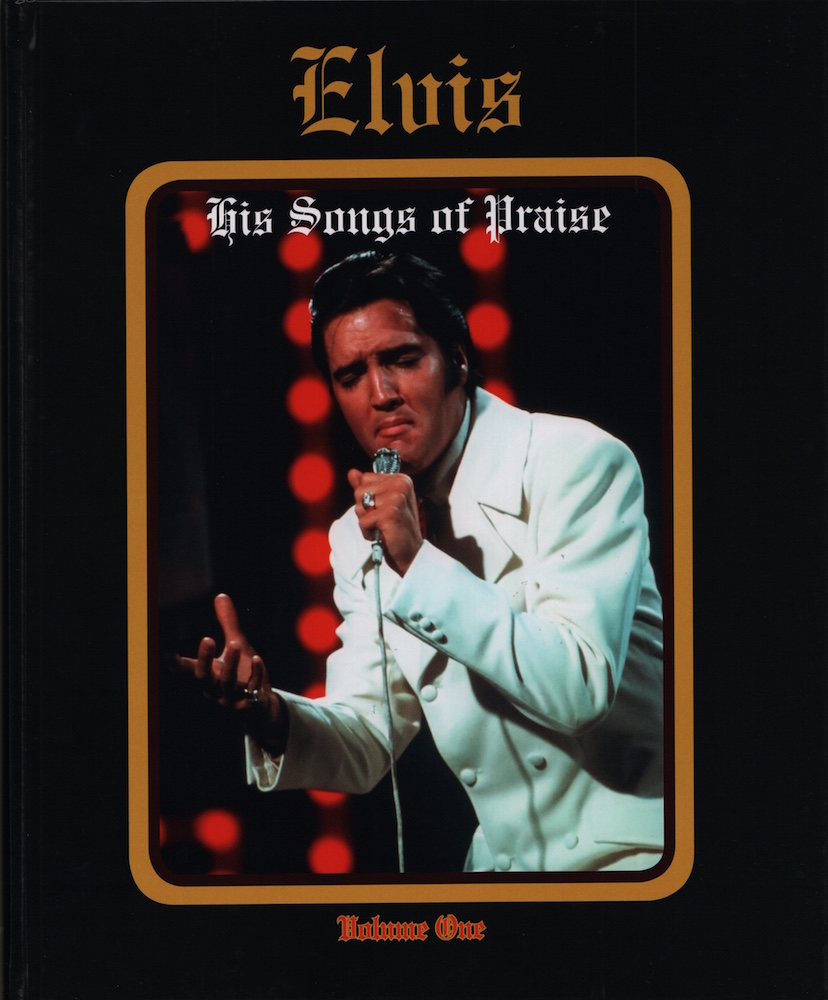
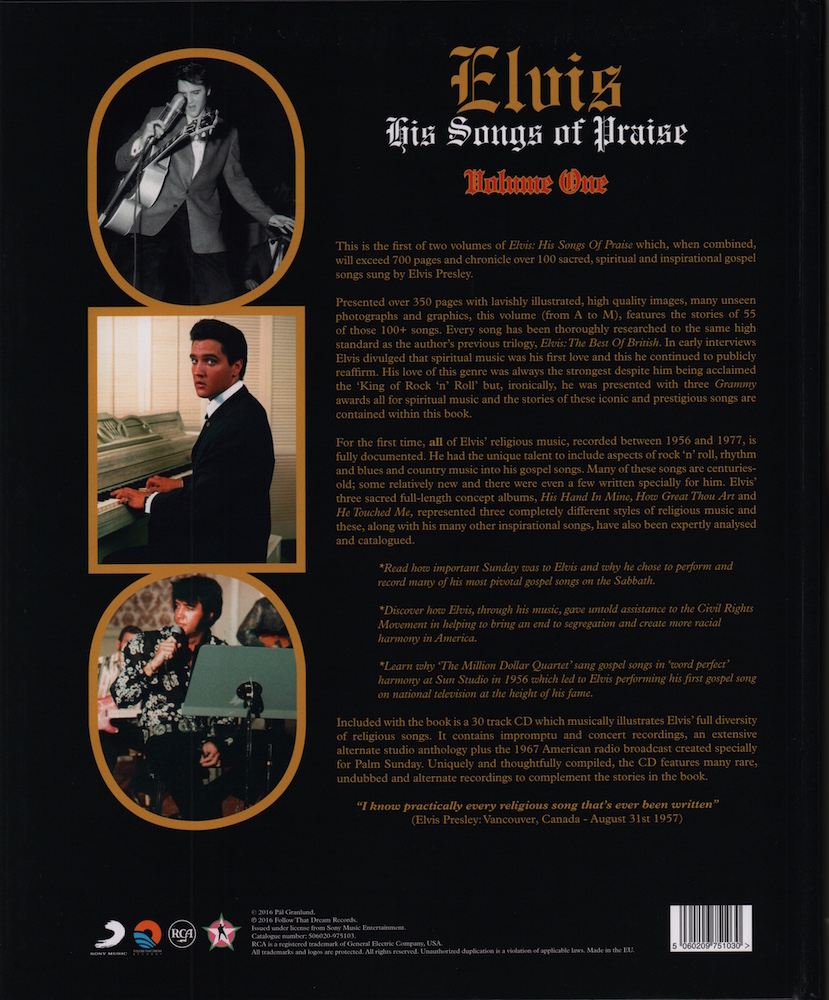
Trevor Simpson’s first book after his trilogy of books on Elvis’ British record releases, Elvis: The Best Of British, is Elvis: His Songs Of Praise Volume 1, which chronicles Elvis’ gospel and inspirational recordings in alphabetical order from A to M.
This is the first of two volumes which, when combined, will exceed 700 pages and chronicle over 100 sacred, spiritual and inspirational gospel songs sung by Elvis.
Presented over 350 pages with lavishly illustrated, high quality images, many unseen photographs and graphics, this volume features the stories of 55 of those 100+ songs.
Every song has been thoroughly researched by the author in the same way as his previous trilogy of books, with every title being looked at in depth, with detail on the song‘s writers, original version, Elvis‘ performance and heaps of other trivia. It all has been so obviously well researched and the attention to detail is staggering, but that said, some errors creep in too, but more on those later!
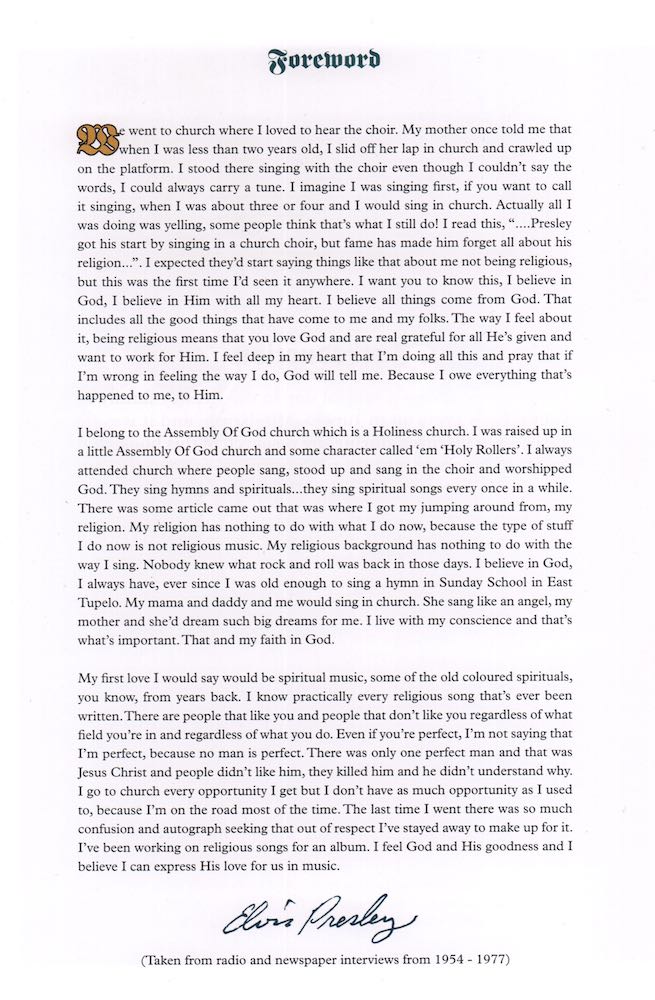
From a very cleverly edited “Foreword”, by none other than Elvis himself (put together using quotes from interviews and the like), the book oozes quality.
Trevor Simpson sums up the book when talking to Piers Beagley on his Elvis Information Network web site ...
“After completing the Best Of British trilogy, I talked with the publishers about future projects and I mentioned that I had always loved Elvis' gospel albums. When it came up in discussions everyone thought it was something that had never been done before, so the hard work in fully researching it all began. When we got into collating the incredible number of songs Elvis recorded with spiritual, inspirational and sacred connections, we realised that it totaled over 100! That means a concept of over 700 pages in book form. With the binding and sheer weight of such a book it was impossible to do and so it is split into two 350+ pages. It will be done alphabetically with the first one being A - M. In many ways the project was difficult but it also provided me with many 'Eureka' moments in discovering things that had never been documented before in terms of Elvis and his music. ‘If I Can Dream’ was always a favourite of mine and was written with the inspiration from the Martin Luther King “I Had A Dream” speech. My research has uncovered several uncanny connections with these circumstances and Elvis.
Two of his three Grammy awards were for How Great Thou Art and as that is a British composition. The Stuart Hine Trust, who manage the songwriting royalties of the composer, allowed me full access to their archives to tell the full story behind this great song and Elvis’ definitive recording. There were so many coincidences along the way and when these are all collated together it really is a spine chilling discovery and an insight into why this music was Elvis' first love and closest to his heart. Many of the older songs came from around the African-American slave era before the Civil War, or were originally from the English churches before they found their way to America. On the Elvis albums, when the publishers could not trace the original songwriter, they settled for “Arranged and Adapted by Elvis Presley” which was a way of avoiding paying any royalties to the original composer. I have, through research, traced some of these songwriters and have also been able to find their stories behind the songs. A secret passion of mine is collecting the original versions of songs that Elvis sang and so my collection of 78s by The Statesmen, The Jordanaires, The Blackwood Brothers and The Golden Gate Quartet etc., all had a part to play in telling the full story of how Elvis got the songs”.
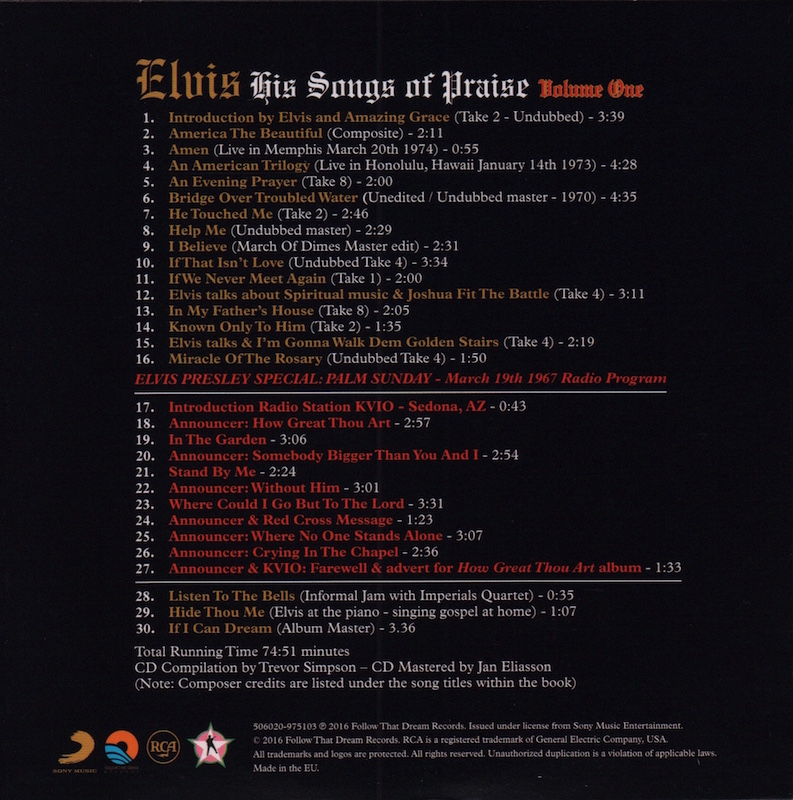
As the accompanying CD is a bonus addition with the book, I thought I’d go through the CD track by track, which has been compiled by Trevor Simpson himself and mastered by Jan Eliasson:
Take 2 of ‘Amazing Grace’ is first up and is the same as first featured on the ‘70s box-set Walk A Mile In My Shoes, but here it contains an introduction beforehand by Elvis, spliced in from The Truth About Me interview outtakes from August 29 1956, in the same way that introductions were edited in before the masters on The Best Of British 1959-1960.
Next is the live and studio composite of ‘America’, which is spliced from the live single master, recorded at the December 13 1975 midnight show in Las Vegas, and the ending of the erased studio version, recorded on February 7 1976 at Graceland, and was first released on FTD’s classic album of Moody Blue in December 2013.
‘Amen’ is the ending from the ‘I Got A Woman’/‘Amen’ medley from the Mid-South Coliseum in Memphis on March 20 1974 that was part of the Elvis Recorded On Stage In Memphis album in 1974.
For the listing of ‘An American Trilogy’ in the book, starting on page 33, the live master is referenced as being from February 16 1972 (midnight show in Las Vegas), and it was this was issued as a single in April 1972, but it goes on to say on page 38 that the most recognized version is the Aloha From Hawaii version from January 12 1973 (the actual Aloha version is from January 14 1973!). On the CD it also lists the Aloha version (this time correctly listing it as being from January 14 1973), but it’s the 1972 single version that is on the CD. Very sloppy!
Take 8 of ‘An Evening Prayer’ doesn’t have the count-in and dialogue that was present on FTD’s classic album release of He Touched Me, although that is where it has been taken from.
Next up is what is listed as being the unedited, undubbed master of ‘Bridge Over Troubled Water’. The master of ‘Bridge Over Troubled Water’ is Take 8, but Elvis did some vocal repairs on some parts ("friends just can't bee-ee-ee found" (1:06) and "When e-eeevening falls" (at approximately 2:00 among others) and also recorded a harmony vocal overdub on the last verse, so I would expect to get the unrepaired, undubbed Take 8 here, without Elvis’ harmony vocal or any later overdubs. What is actually on the CD is Take 5, lifted from Essential Elvis Volume 4: A Hundred Years From Now. Come on Trevor, who are you trying to kid?
Take 2 of ‘He Touched Me’ is next but doesn’t contain as much dialogue beforehand that was present on FTD’s classic album release of He Touched Me, where it has been taken from.
Take 1 of ‘Help Me’ is the undubbed master but doesn’t contain the false start beforehand which can be heard on FTD’s classic album release of Promised Land.
‘I Believe’, which I consider to be one of Elvis’ greatest gospel recordings, has a “March Of Dimes” radio spot edited on to the beginning, which was first heard on FTD’s Easter Special, but doesn’t do anything to enhance the song here.
Take 4 of ‘If That Isn’t Love’, which is the undubbed master, is next and was first heard on FTD’s classic album of Good Times.
‘If We Never Meet Again’ is listed as Take 1, indicating an alternate take, but it’s just the regular master. Even FTD’s classic album of His Hand In Mine had the original session mix of ‘If We Never Meet Again’ and count-in beforehand.
Take 4 of ‘Joshua Fit The Battle’, is preceded by a segment from the Vancouver Press Conference from August 31 1957, which is edited in. This is the actual master of ‘Joshua Fit the Battle’ but here it contains some additional dialogue beforehand, which was released on the bootleg box-set Unsurpassed Masters, and is previously officially unreleased.
Take 8 of ‘In My Father’s House’ is next, and has only been released on bootleg until now, and is, therefore, previously officially unreleased. This is the take that was used for the master, but the master had a “work part” ending spliced to the end.
Take 2 of ‘Known Only To Him’ has been released on FTD’s His Hand In Mine classic album and Easter Special, but here it doesn’t contain the count-in beforehand, which is present on the other releases.
Take 4 of ‘I’m Gonna Walk Dem Golden Stairs’ is next and is sung at a slower tempo than the master (Take 1), and was first released on FTD’s classic album of His Hand In Mine, where it also had the count-in before the take which isn’t present here. Here it is preceded by a segment from the Vancouver Press Conference from August 31 1957, which is edited in.
The undubbed master of ‘Miracle Of the Rosary’ (Take 4) is next, and is previously officially unreleased. It has only appeared before on the bootleg Unedited Masters - Nashville 1971 on the Venus label.
Next up is a radio show, which was first broadcast on March 19 1967 entitled Elvis Presley Special: Palm Sunday. This is the first official release of this radio show although it has been out on bootleg before on Seasons Greetings From Elvis, which also contained The Christmas Special radio show from December 3 1967. But here the start and end of the radio show comes from a different source to the actual show itself. It’s very nostalgic for me listening to the likes of these radio shows, especially as I wasn’t born until 1969, so this is a very welcome addition to this CD, and a nice touch.
More gospel influenced tracks follow starting with Elvis singing an informal part of ‘Listen To The Bells’, which is from before Take 4 of ‘A Thing Called Love’ from the May 20 1971 recording session. Sadly, in the book (page 327) Trevor mistakenly states that it was caught on tape from before Take 9 of ‘It’s Only Love’, as it was edited in before Take 9 of ‘It’s Only Love’ on Essential Elvis Volume 4: A Hundred Years From Now. He must not have remembered that it had been released in its correct context on FTD’s He Touched Me classic album!
The short February 1966 home recording of ‘Hide Thou Me’ is next, which was first released on FTD’s In A Private Moment. Perhaps it is due to time constraints that the different, longer home recording, first released on the Today, Tomorrow And Forever box-set and later on the I Believe: The Gospel Masters and The Complete Elvis Presley Masters box-sets, wasn’t used instead, as it would have been more apt.
Rather than using the better stereo master, closing the CD is the original mono album version of ‘If I Can Dream’ , as featured on the NBC-TV Special LP in 1968, containing overdubbed applause and Elvis’ “Thank you, goodnight” ending.
All in all, even with the errors, this is a great book and CD set, and a great read, and I am looking forward to the next volume.